
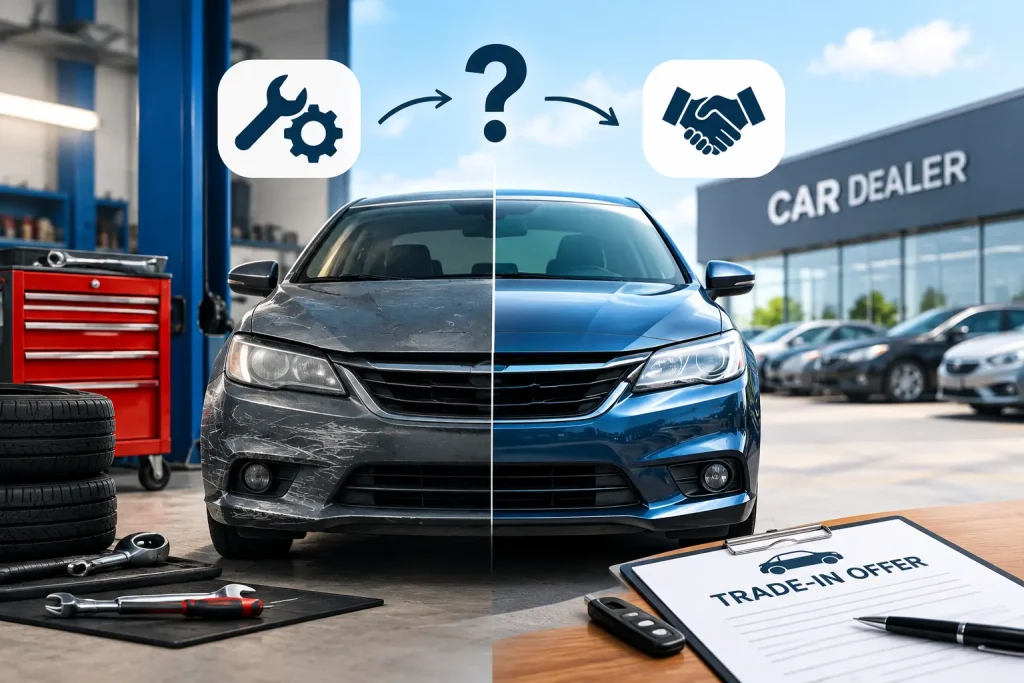
A $600 repair bill doesn’t automatically add $600 to your trade-in offer. Most sellers assume it does. Then they hand over a receipt for new brake pads and watch the dealer’s number barely move. If you’ve asked yourself should I fix my car before selling it to a dealer, the honest answer depends on what’s broken and what it actually costs to fix.
Key takeaways:
- Get a written as-is offer before spending a dollar on repairs. It’s your only real baseline.
- Small cosmetic fixes under $150 usually pay off. Big mechanical jobs almost never do.
- A $2,625 transmission rarely earns back its cost on a $6,000-$9,000 car.
- PA inspection failures, rust, liens, and salvage titles all change the math, and most guides skip them entirely.
Why the Old Trade-In Math Doesn’t Work in 2026 – 27
The old advice was simple: get a repair quote, compare it to the value bump, fix it if the numbers work. That still sounds reasonable. The problem is the numbers themselves have moved.
AAA reported that drivers spent about $1,656 a year on maintenance, repairs, and tires, according to ClickOrlando’s 2026 coverage.
A separate 2026 repair-cost report tracking 102 jobs found a median repair cost of roughly $725, with prices ranging from about $50 for a sensor to $8,000 or more for a hybrid battery. Labor rates are climbing too.
A UK reliability index found hourly labor rates rose nearly 8% over three years, and Central PA shops aren’t immune to that same pressure.
Here’s what that means in practice: a job that felt like a $300 fix five years ago might run $500 today. Cross that break-even line without knowing it, and you’ve spent real money for zero return.
The framework this article uses is simple: get an as-is offer first, get a repair quote second, then compare the gap. Everything below builds on that order. It’s the same order our own buyers walk sellers through, and you can see it laid out further in our car selling guides.
Should I Fix My Car Before Selling It to a Dealer? Run These Numbers First
This is the question every seller should ask before touching a wrench or a checkbook. Should you fix the car, or sell it exactly as it sits? The answer depends entirely on what’s broken.
Say you own a car worth $6,000 as-is, and the transmission needs work. According to CarSaver’s 2026 cost data, a transmission job runs about $2,625. Spend that, and you’ve put nearly half the car’s value into a single repair that a dealer won’t fully credit back. That math almost never works, no matter how you run it.
Now flip the scenario. A $9,000 car with a $150 windshield chip or a $60 headlight bulb is a different story entirely. These are the repairs worth doing:
- Windshield chips under $150
- Burned-out bulbs
- Missing wiper blades
- Torn floor mats
CarSaver’s benchmarks put an engine replacement at $3,468 and an A/C overhaul above $1,100. Compare those against a typical Central PA trade-in range, and the picture gets clear fast. Mechanical repairs rarely pay for themselves once you know how trade-in value is calculated.
Dealers already expect to recondition mechanical issues. They price the whole car as a package, not repair-by-repair, so spending on an engine or transmission before you sell almost never moves the offer as much as you’d hope.
EV owners face the steepest cliff of all. Battery pack replacements run $12,000 to $20,000, according to a 2026 report on expensive repairs, with some cases topping $25,000. Selling as-is is almost always the smarter move here, and it isn’t close.
What Central PA Sellers Get Wrong About Inspection, Rust, and Liens
Pennsylvania’s state inspection creates a pressure point most sellers don’t think through. If your car would fail inspection today, that failure only matters to a buyer who requires one. A buyer purchasing as-is skips that requirement entirely, removing the pressure to fix brakes, tires, or exhaust issues just to pass a test nobody’s giving.
Rust Is a Regional Problem, Not a Repair Checklist
Road salt hits Dauphin, Cumberland, and Lancaster County vehicles hard every winter, the same way it eats away at guardrails and bridge supports across the region. Rust and corrosion are common enough that most cash buyers price them into the offer rather than expect you to fix them first.
Trying to repair rust before selling is usually a losing trade. Bodywork costs add up fast, and the value recovered rarely matches the bill.
Loans, Liens, and Negative Equity
If you still owe money on your car, the math shifts again. Buyers who handle loan payoff directly let you skip repairs and roll any negative equity into your next purchase instead. Spending cash on a repair for a car you don’t fully own yet rarely makes sense compared to letting the buyer settle the lien, a process we cover in our guide on selling a car with a loan.
Salvage Titles Don’t Respond to Cosmetic Fixes
Salvage-title vehicles get discounted differently depending on who’s buying. A cosmetic repair, a new bumper, fresh paint, rarely closes that gap. The title status itself is doing most of the discounting, not the condition underneath it, which is why selling a salvage title car works differently than a standard trade-in.
This is where a written offer matters most. Get one first, from a buyer who works with loans, liens, salvage titles, and even missing titles, and you’ll know your real number before spending anything.
We’ve bought vehicles across these exact situations as a family-owned car dealer based in Middletown since 1939, with same-day payment and no haggling over what the offer means.
If you’re still weighing whether fixing your car before selling it to a dealer is worth the trouble, start with the number, not the guesswork. Get My Cash Offer at selltocramer.com and see your real, written as-is value in about 60 seconds, before you spend a cent on repairs.
Frequently Asked Questions
Should I fix my car before selling it to a dealer if it needs a new transmission?
Usually not. A transmission repair runs about $2,625 according to 2026 cost data, and that rarely gets recovered in a trade-in offer on a car worth $6,000-$9,000.
Does a cracked windshield hurt my trade-in offer?
Yes, and it’s cheap to fix. Windshield chips under $150 are one of the few repairs that reliably pay for themselves before a sale.
What if my car has rust damage?
Most cash buyers in Central PA price rust into the offer rather than expect repairs first. Fixing rust before selling rarely recovers its cost.
Can I sell a car with an active loan or lien?
Yes. Buyers who handle payoff directly let you skip repairs and roll any negative equity into your next vehicle instead of spending on fixes.
Do salvage titles get discounted the same way everywhere?
No. Different buyers discount salvage titles differently, and cosmetic repairs rarely close that gap since the title status drives most of the discount.